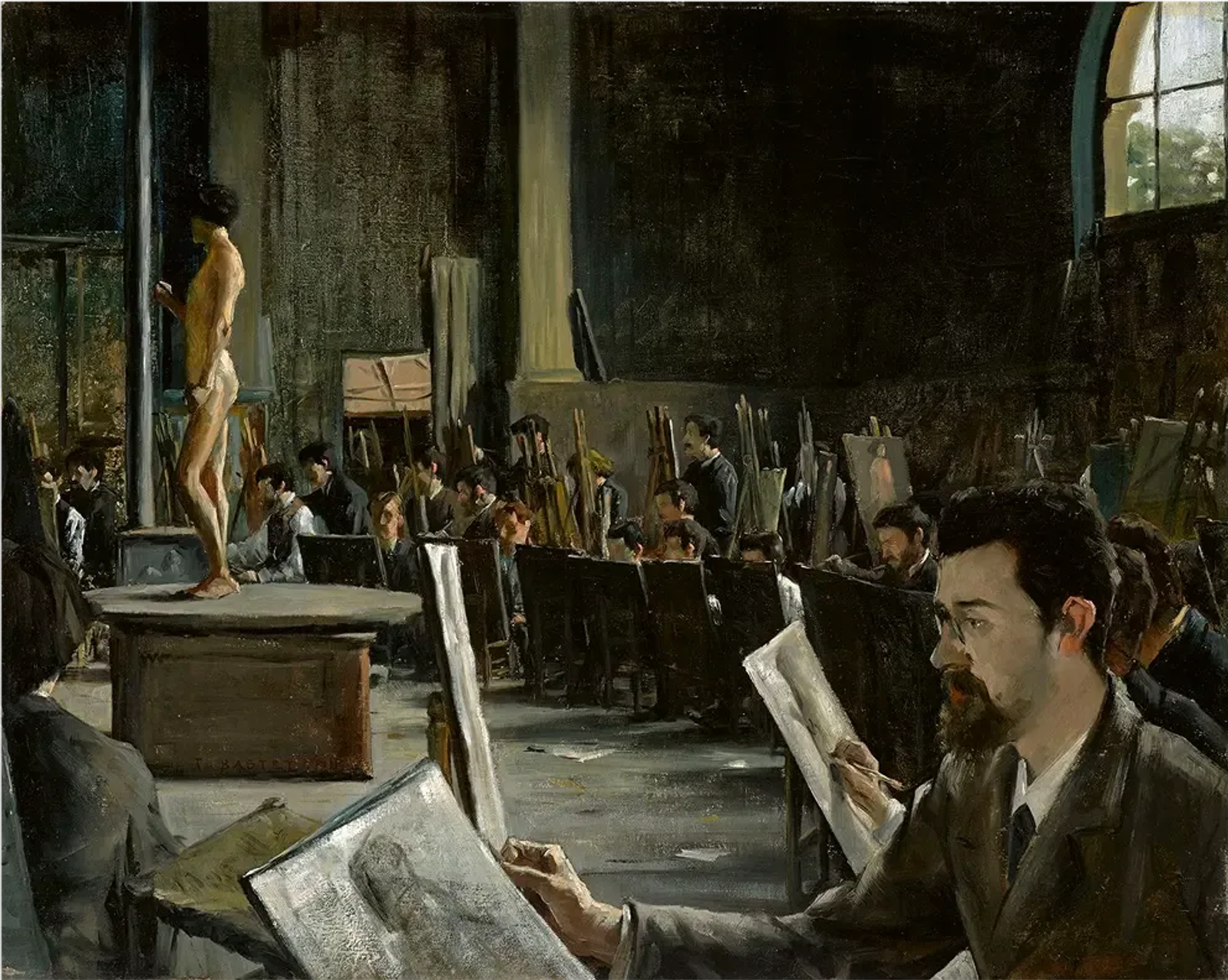
A Curated Reading List for Understanding French Academic Art and Training Methods
There are countless drawing and painting books available, each with its own approach. For beginners, it can be hard to know which one is worth the time. We focus on the 19th century not just because of the incredible academic work these artists produced, but also because of the wide range of styles that emerged from that training.
One of the most common questions we get is: “How do I learn more about 19th-century art?” Below is a curated list of the most important books to understand the culture, practices, and techniques of 19th-century French academic art. Some are historical accounts, others are practical guidebooks that detail methods and exercises used at the time. We’ve organized them into three clear categories so you can easily browse based on whether you want cultural context, technical training, or in-depth historical insight.
1. Life in 19th-Century Paris
These books focus on the culture, experiences, and everyday life of artists studying in Paris during the 19th century. They are a good place to start for context before diving into the technical material.
An Art Student’s Reminiscences of Paris in the Eighties by John Shirley Fox (1910)
A fun read about the adventures of a young artist at the École des Beaux-Arts. Shirley fox gets left in Paris alone at 13 years old to study with Bouguereau, Gerome and other notable French Masters.
Bohemian Paris of To-Day (1899)
A great glimpse into life at a 19th century Parisian atelier. Packed with detailed illustrations and fun stories.
Lectures on Painting by Edward Armitage (1883)
Student of Paul Delaroche, the same teacher who taught Yvon, Gérôme, and Boulanger. Armitage’s lectures are a gem. He breaks down a range of topics from historical painters to academic practices in different schools, along with practical ideas for painting and drawing.
Audiobook alternative available here
The École des Beaux-Arts and the Prix de Rome: Student Life and Academic Training in 19th Century Paris by Ramon Hurtado (2024)
A clear summary of research on 19th century French academic training. It covers student routines, studio culture, and how the system shaped artistic development.
2. Technical Training and Studio Practices
These books give structured guidance on drawing, painting, and anatomy. They reflect approaches and materials used in 19th century ateliers.
Drawings in Charcoal and Crayon for the Use of Students and Schools by Frank Fowler (1899)
Fowler was a student at the École des Beaux-Arts. The gold standard for the basics of 19th century French academic drawing. Fowler covers the essential tools, elementary exercises, and the full approach for drawing a portrait. Highly recommended. Download all plates and text from our article on Bargue plates!
Fowler Has two other books which are not as fundamental as Drawing in Charcoal and Crayon but worth looking into if interested:
- Portrait and Figure Painting by Frank Fowler (1901)
- Oil Painting: A Handbook for the Use of Students and Schools by Frank Fowler (1903)
Charles Bargue Drawing Course by Charles Bargue and Jean-Léon Gérôme (1860s–1870s plate series)
Extremely high resolution collection of the entire Charle’s Bargue Drawing course from the French archives. Bargue developed these plates alongside Gerome to be copied by students for beginners practice. If you want to learn more we wrote a whole article on it: Bargue Drawings: Facts, Fiction and How to Do Them!
Constructive Anatomy by George Bridgman (1920)
Bridgman was a student of Gérôme and Boulanger. Extremely famous and often recommended. Bridgman’s diagrams clearly show how the parts of the body fit together with rhythm and structure. Think of them as diagrammatic explanations of his teaching This book is often handed to beginners, but that is not ideal. The drawings are exaggerated to teach ideas and should not be copied literally. There is a lot of value here, especially for students who are already somewhat familiar with anatomy. Bridgman’s scribbly, charismatic style exists to deliver information efficiently and to demonstrate forms and mechanisms. People often try to imitate the appearance of the drawings, which gives little benefit.
The Human Figure by John H. Vanderpoel (1907)
Vanderpoel was a student of Lefebvre and Boulanger. Very clear diagrams and renderings of the figure. It is more practical than Bridgman and makes it easier to see how these ideas apply to real drawings.
Modelling by Edouard Lanteri (1902)
Lanteri was a professor of Sculpture at the Royal College of Art. One of Ramon’s favorite anatomy resources. It begins with simple planes and continues to small forms. Written for sculptors, but the information and diagrams are so strong that it is valuable for all artists. Highly recommended.
Lanteri has a few other books for those interested:
- Modelling and Sculpture: A Guide for Artists and Students, Volume 2 by Edouard Lanteri (1911)
- Modelling and Sculpture: A Guide for Artists and Students, Volume 3 by Edouard Lanteri (1913)
- Modelling and Sculpting Animals by Edouard Lanteri (1911)
Strength Training Anatomy by Frederic Delavier (1998)
Delavier trained at the École des Beaux-Arts in Paris in the late 20th century. Extremely valuable for understanding how the body looks in motion. Several related books have been added to the series and they are all strong resources.
The Painter in Oil by Daniel Burleigh Parkhurst (1898)
Parkhurst was a student of Bouguereau at Académie Julian. An excellent and thorough guide to oil painting materials and techniques. Packed with illustrations and practical examples
3. For the Art Nerds
These books dig into letters, lectures, and first-hand accounts. They are useful if you want the details of training and the differences between European schools.
Ten Lectures on Art by Sir Edward John Poynter (1879).
Poynter was the president of the Royal Academy, he also trained in Paris under Charles Gleyre. Similar to Armitage's Lectures, covers a variety of topics. Includes insightful comparisons between the French and English education systems.
The Life and Letters of J. Alden Weir by Lawrence Park (1917)
An inside look at Gérôme’s teaching at the École des Beaux-Arts. The book includes letters that Weir wrote to his family while studying in Paris. He describes the academic drawing approach and daily life inside Atelier Gérôme. Finding a print can be challenging and the book is still in copyright, so you’d need to purchase a copy.