I’ve found myself with a great desire to do more than just study art skills. The beginning of my artistic endeavors were founded on simple curiosity, but the more I trained the greater my ambitions became. While the artists I came to love did train to be masters of their craft, the impetus that brought them into my view centuries later was their dedication to creating great works of art. How could I do anything except emulate them? To make great works I needed to build a foundation of knowledge. I lacked the draftsmanship skills to even begin conveying my ideas effectively on paper. I couldn’t represent the effect of light on a scene or express the raw emotion behind a person’s character. Fortunately, I happened upon a historical training philosophy that would become an empowering catalyst to my artistic abilities.
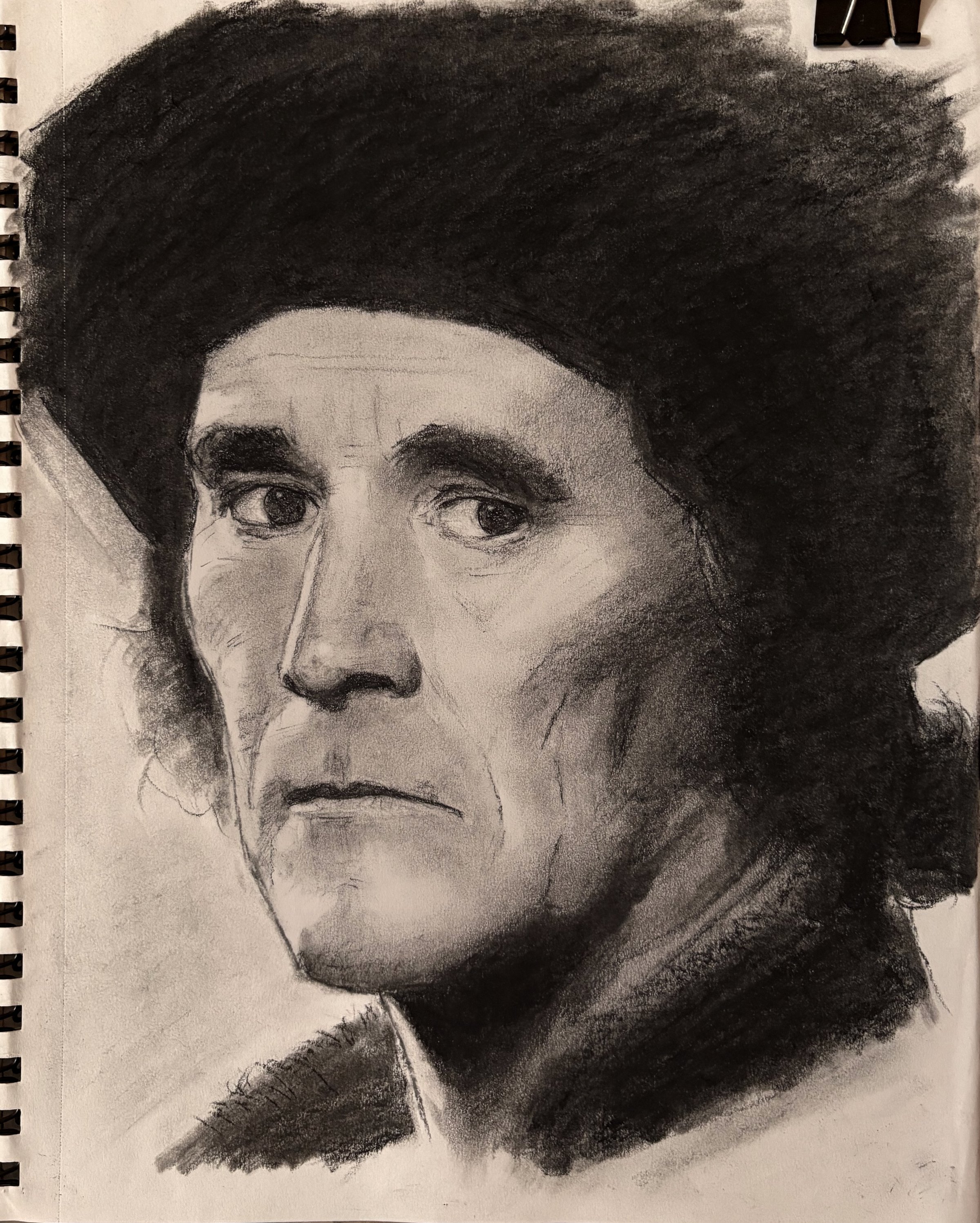
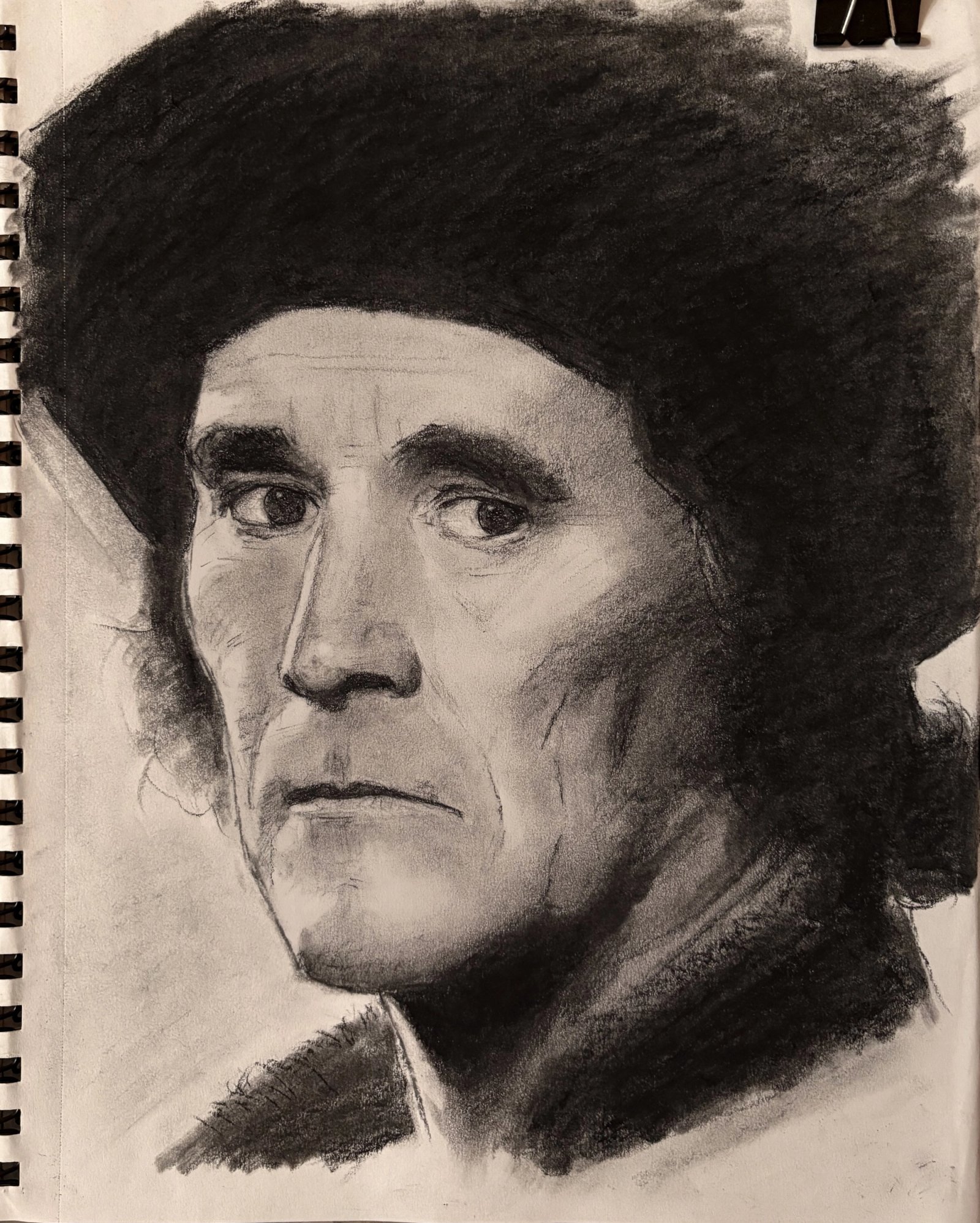
This drawing I made about a year ago was the culmination of my curiosity: drawing most days, watching free tutorials, and pushing myself to try new things. It’s a decent portrait and I was proud of it, but in hindsight I know I didn’t understand what I was doing at the time. I opted for naive observation when I didn’t have the knowledge or ability to understand relationships between structures and light. It took me 6 hours to complete the portrait because most of what I’m doing is guessing.
Of course, I wanted to keep getting better. It wouldn’t have been all that hard to continue drawing consistently and scrolling through Pinterest to find references. That alone could carry you forward, but it also felt a little aimless. I started to be bored of it and found myself unsure of what to draw next. Luckily around this time, among the wash of YouTube tutorials and reddit recommendations, a Youtuber called JakeDontDraw had piqued my interest with his talks of 19th Century training. The historical aspect of it personally interested me, but the training felt more substantial and simple than anything else I saw on the internet. To me it sounded like a craftsman’s approach to training: refining a basic set of skills that inherently allow for a greater capacity of work.
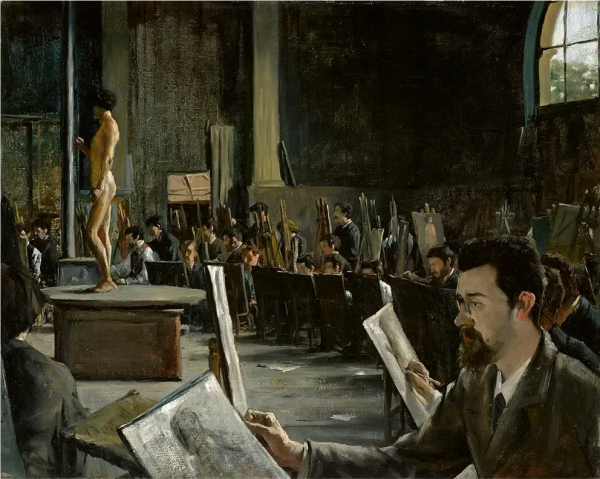
The structure of 19th Century French training was drawing the figure constantly while being directed by the materials used, adhering to time limits for studies, and “graduating” to different dimensionalities of work. I use quotes because these graduations are done loosely (as the French do), and my guess is that these systems are put in place to run a school as much as it is to teach students. The students were started on drawing from the cast or sculpture. Once they achieved a tolerably fair drawing they were moved to drawing from the model, which is a person that poses for them. These drawings were generally done for 12 hours on 18”x24” paper and with charcoal and stump. Once they got good, they were moved to painting, which required them to not only manage the drawing but also colors and mixing. Bargue plates could also be considered a stepping stone to this type of academic training.
Those French students made a 12 hour drawing every week for years at the École des Beaux-Arts. I figured that if they could make hundreds I could make one (a maxim that sums up the simplicity and ease of picking up the structure).
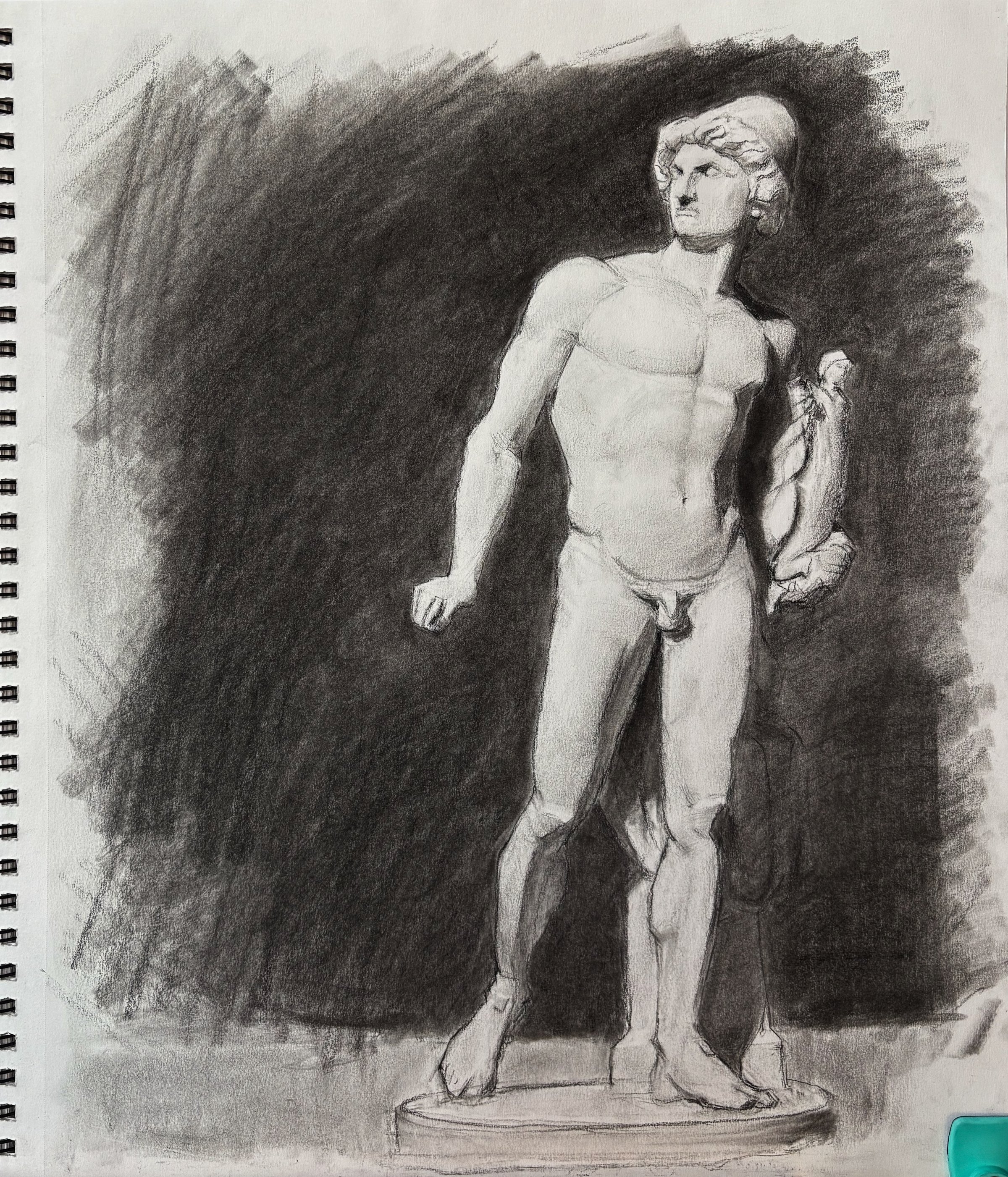
This was my one. It’s not done on the prescribed paper, and I spent 7 hours on it instead of 12, but none of that really matters yet. I spent as long on it as I could (not to mention it’s the longest I had ever spent on any drawing) and followed the general advice given by Jake which includes counting the head heights of the figure, spending a while on the general block-in to place the proportions, and finding a separation between light and shadow. I was proud of this because I gave my best effort and I understood the purpose of the practice. Once finished I only had a taste for more.
I was still trying to understand how to manipulate charcoal and stump. It can feel clunky, and the sticks and crayon require more maintenance to keep sharp than a graphite pencil. I was also not using enough charcoal material; much is needed to create convincing light. But most of all, I needed to improve my fundamental skill of observation. More high effort drawing would be tremendously helpful for these responsibilities.
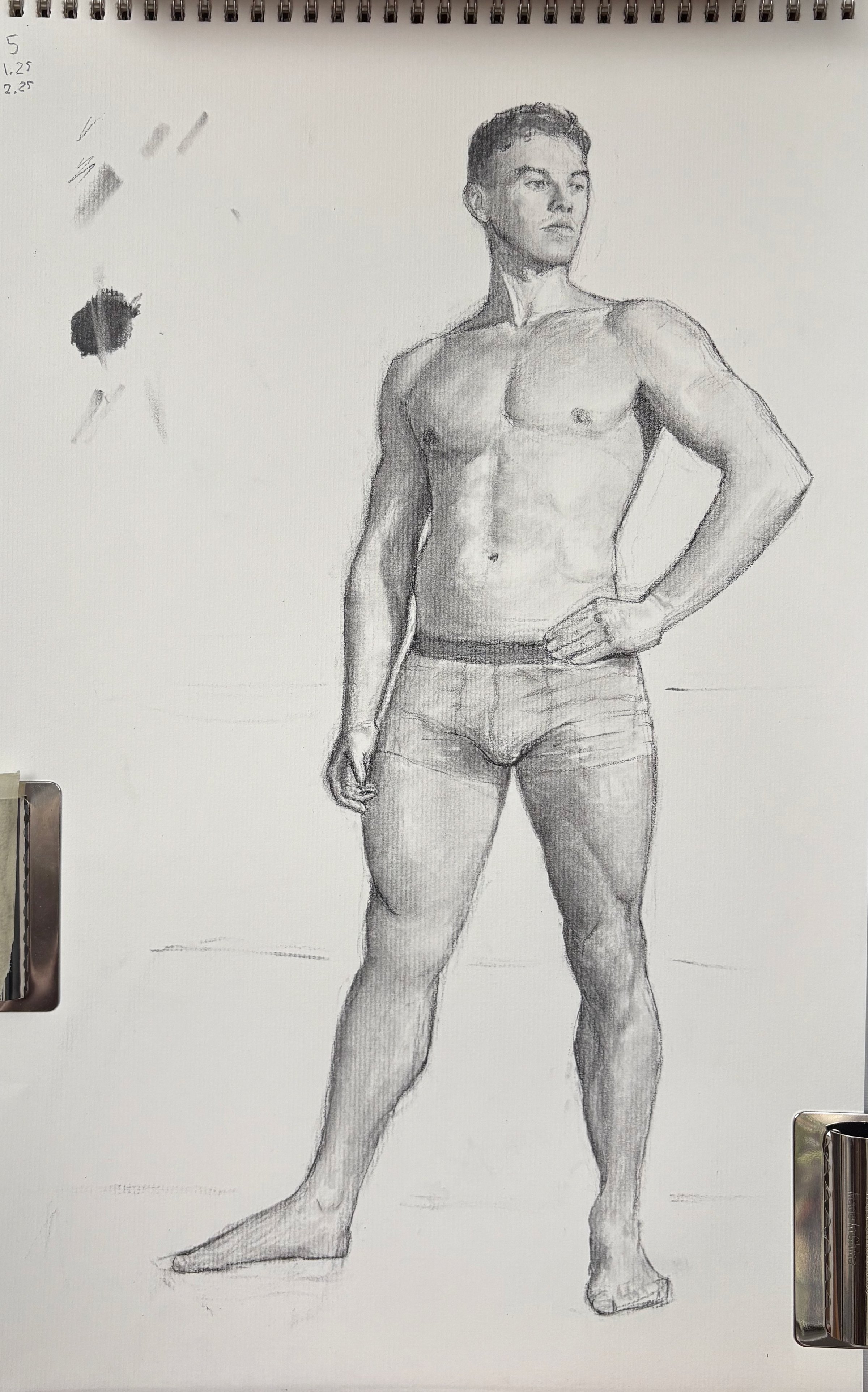
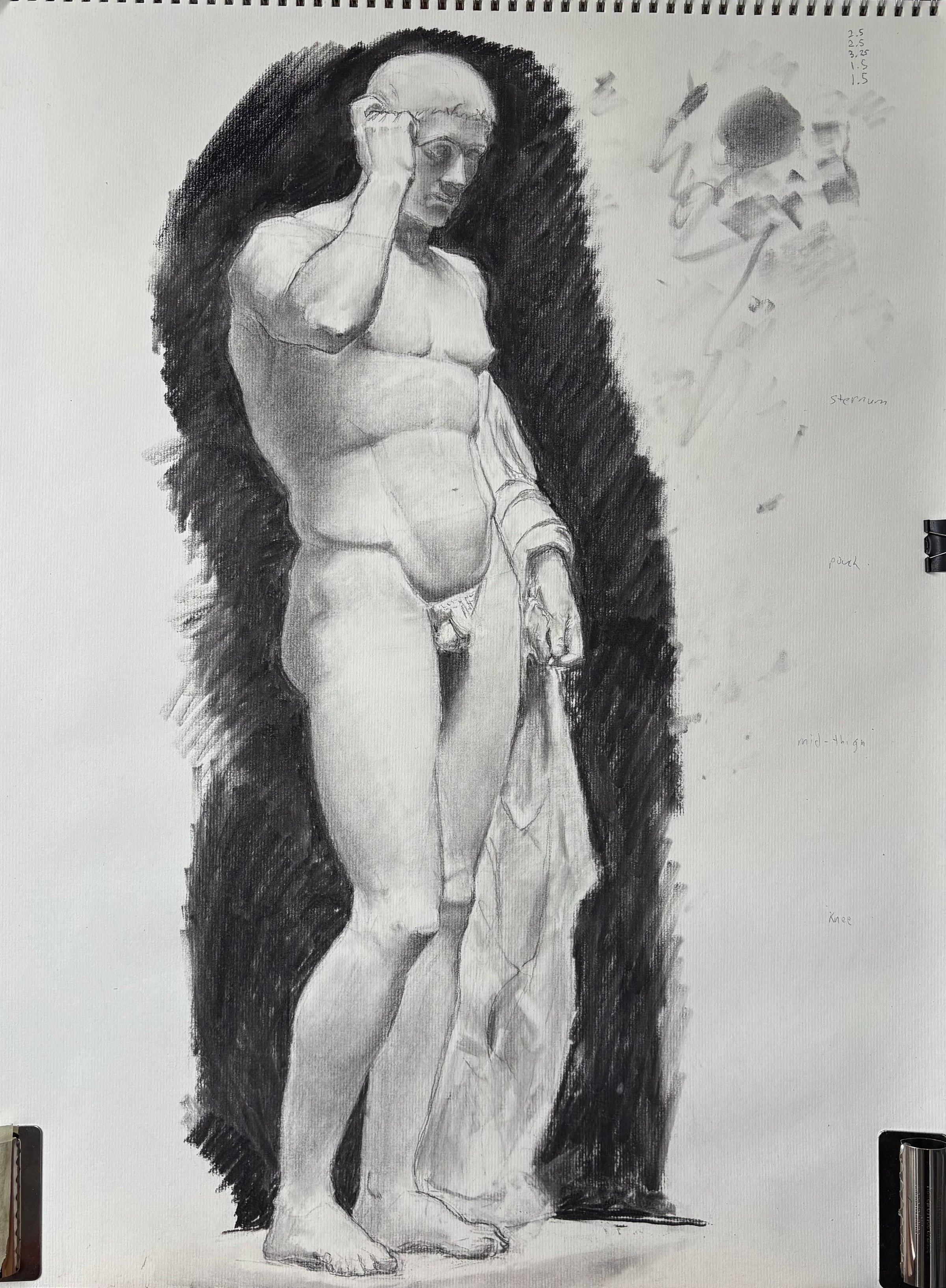
Over the next two charcoal figures I started to get better proportional accuracy. I’m spending all of my brain bytes trying to put down decent lines at the correct angles as well as managing my materials. Many problems of the first drawing remain, but there is substantial improvement in my ability to represent a natural looking figure. I also begin to follow the prescribed materials more closely. With this experience and Jake’s guidance I started to build the context needed to understand what it means to model forms with light and shadow.
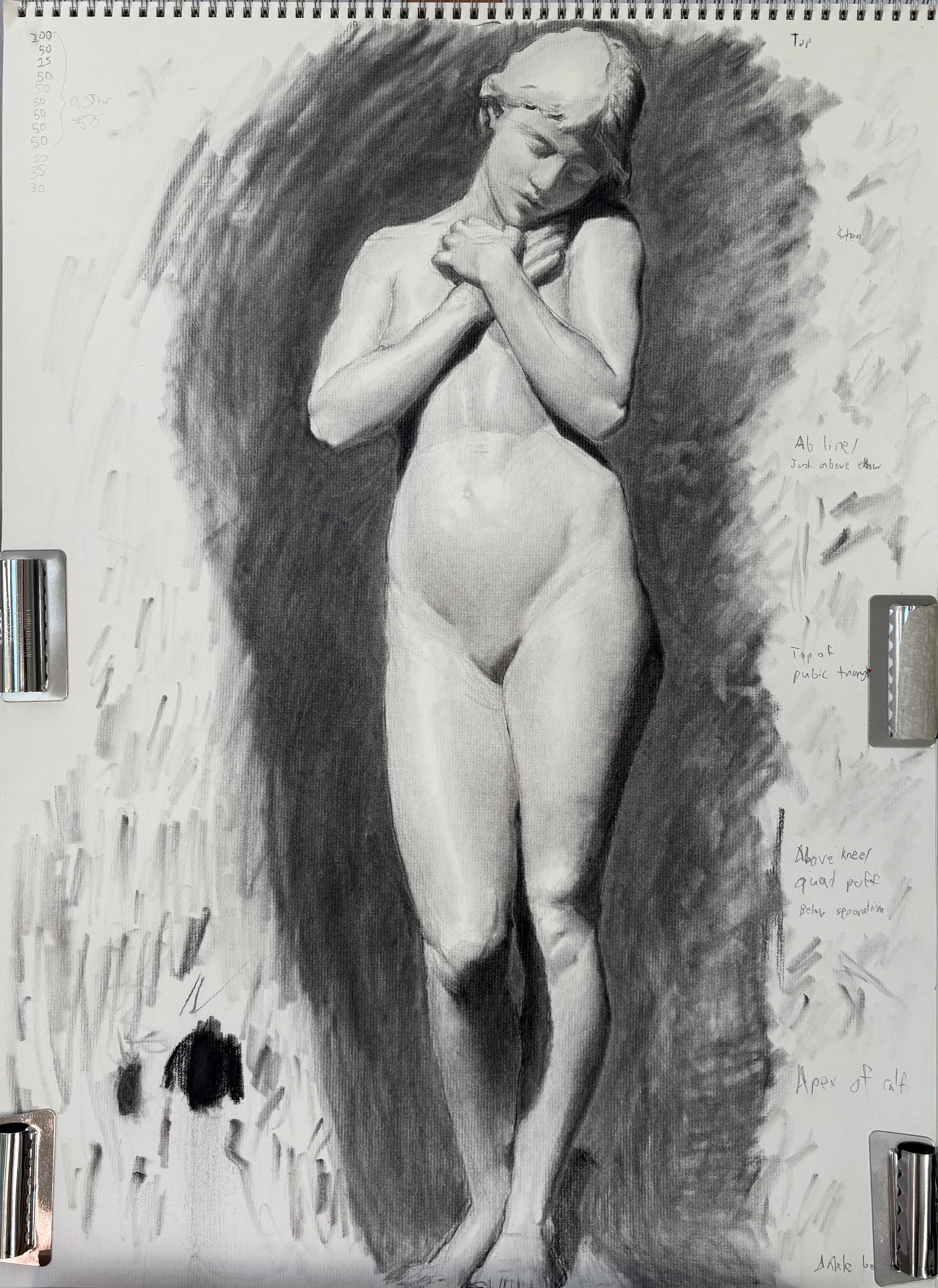
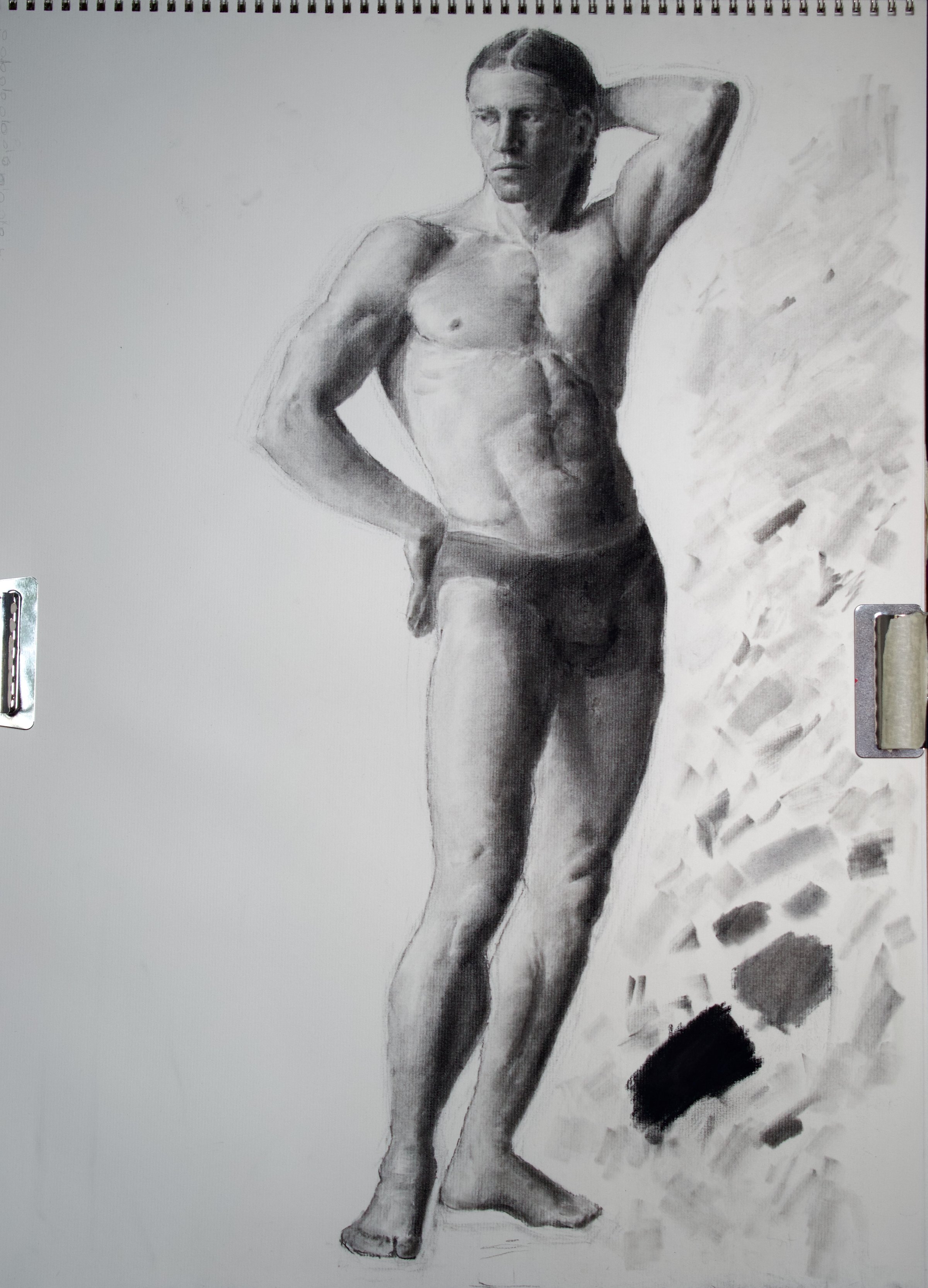
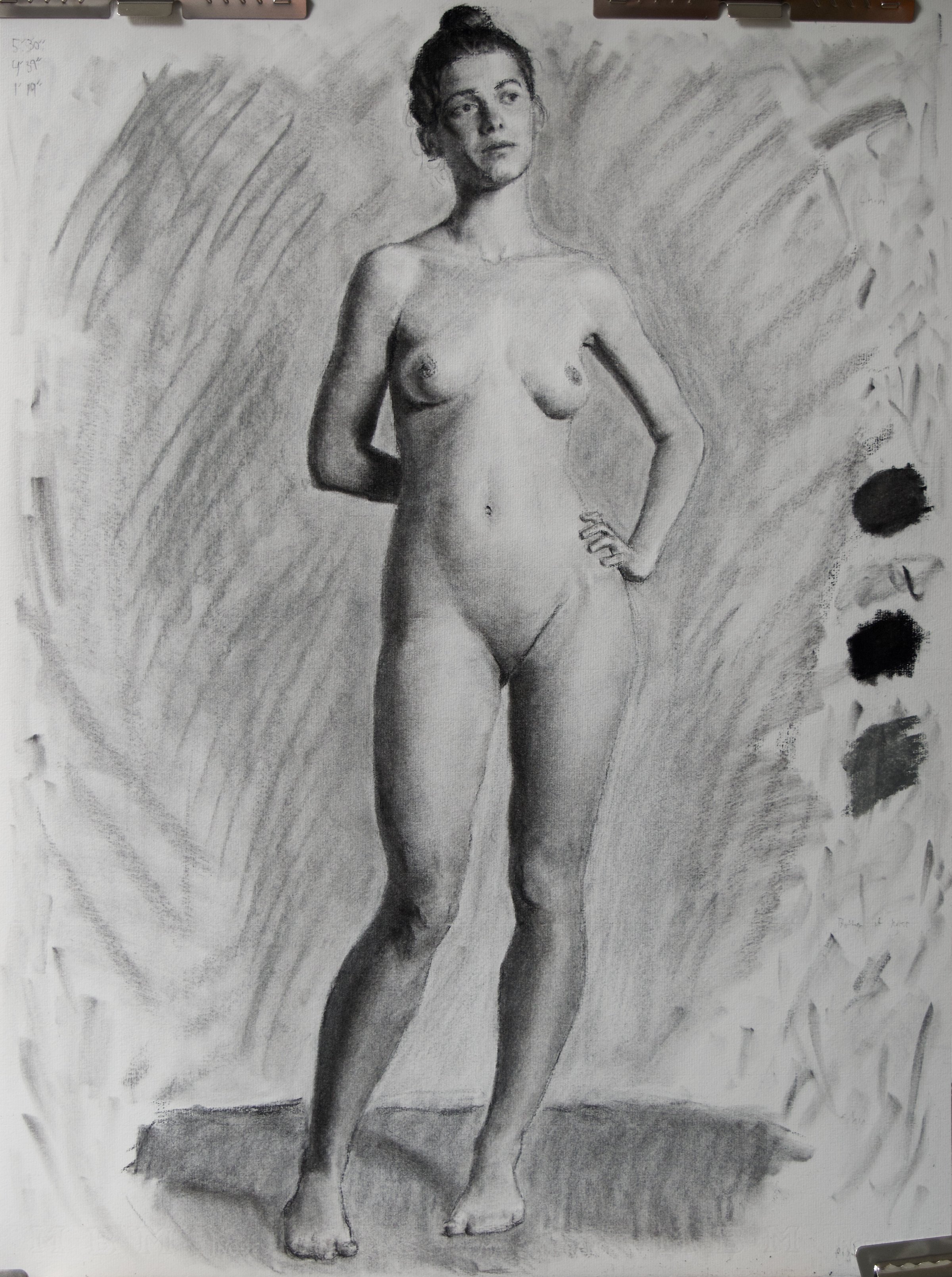
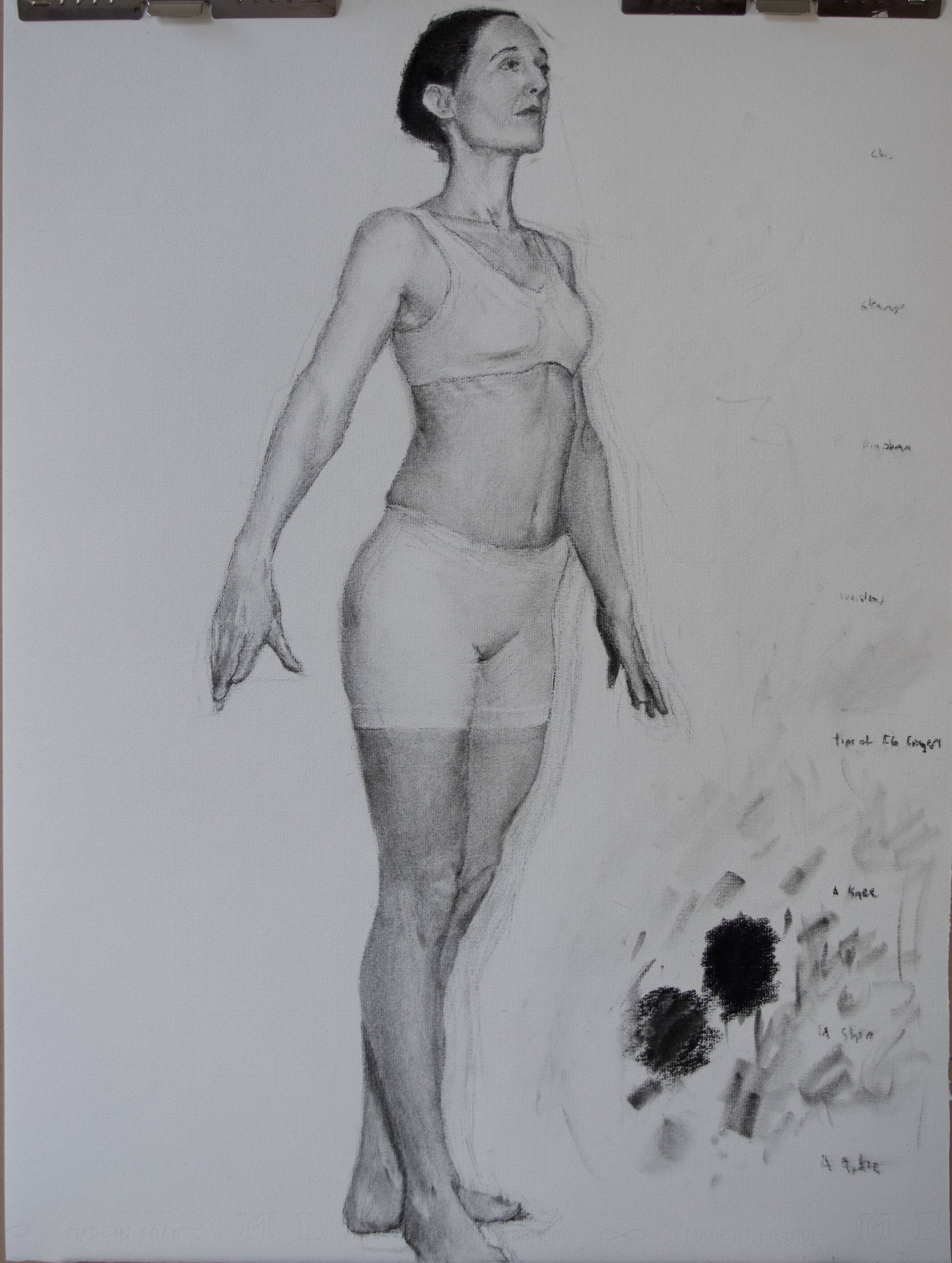
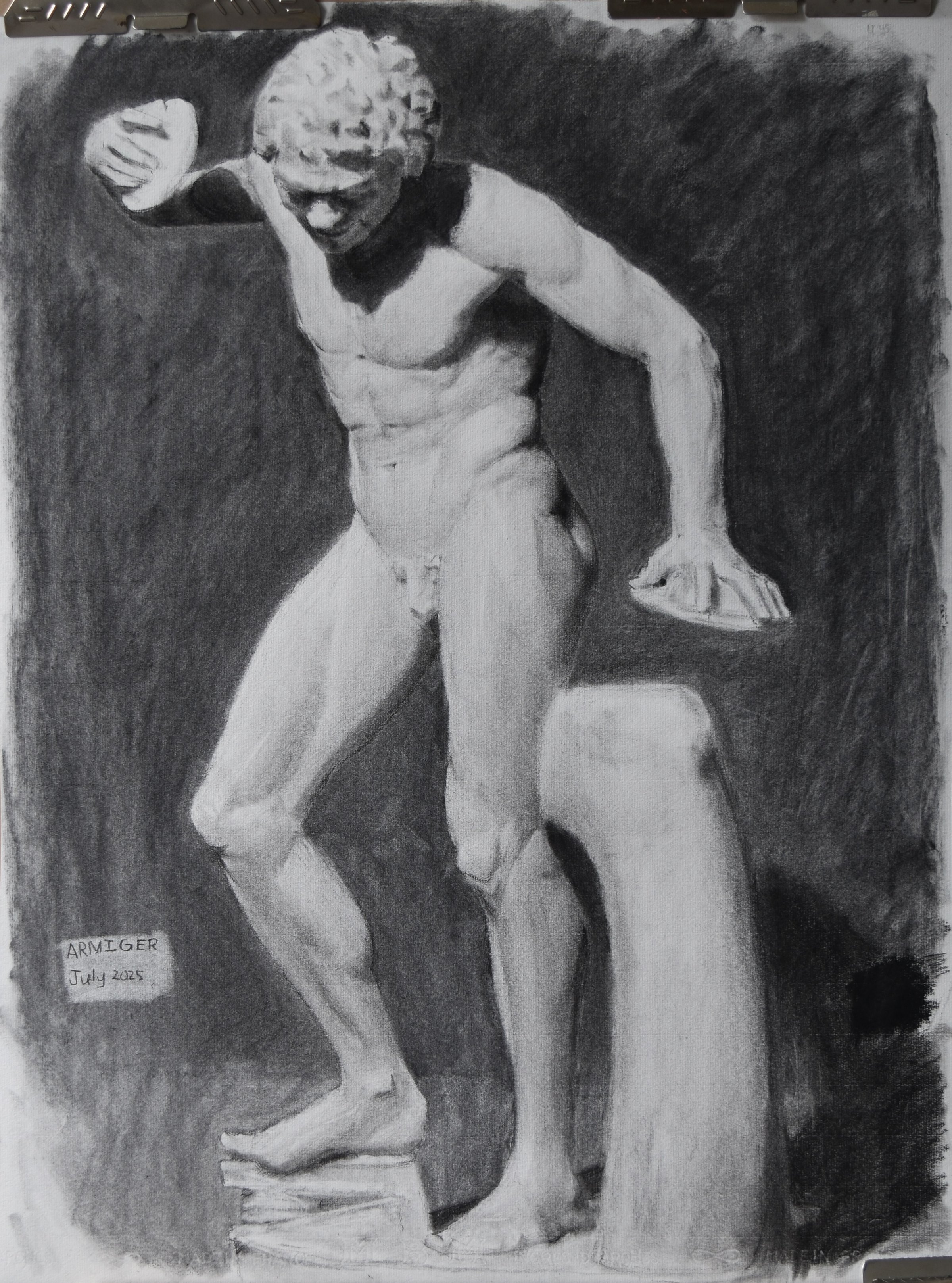
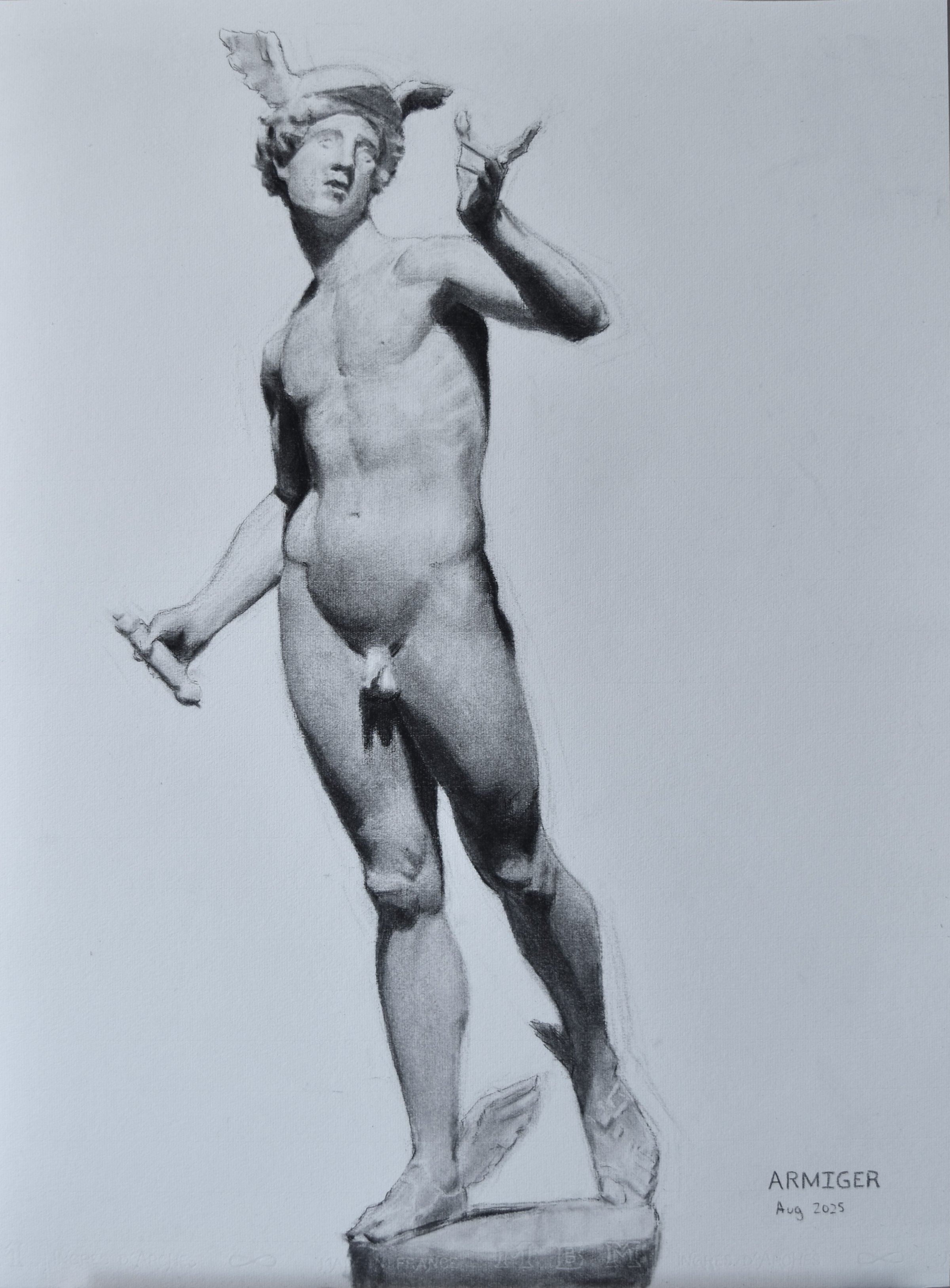
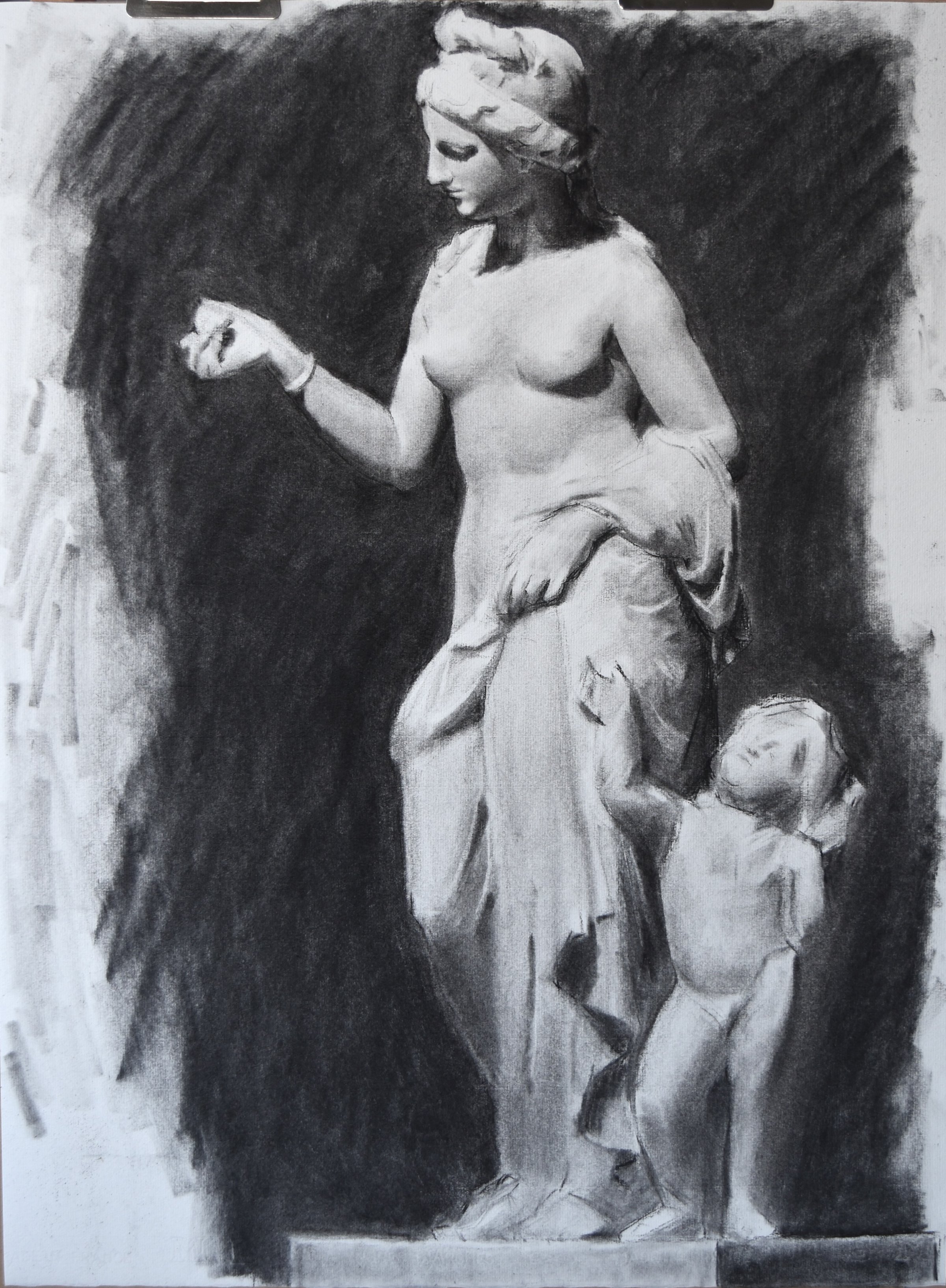
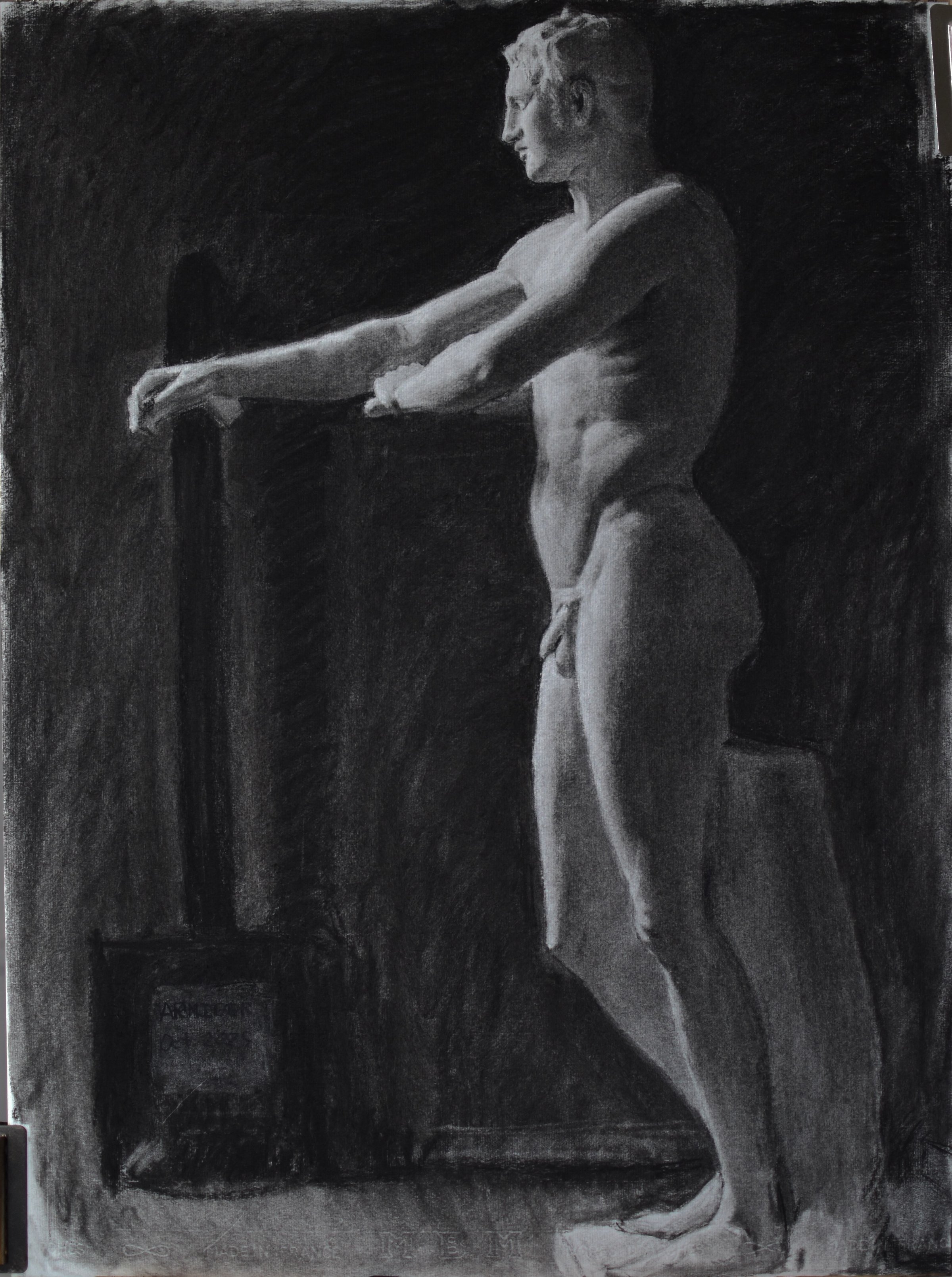
I then take up charcoal figures like it’s my job. The rest of these are done in the remainder of the year. Not every drawing is necessarily more successful than the last, but in each one I was pushing different ideas whether it was finding accuracy and rhythms, modeling forms, or making a striking ensemble by controlling gesture, light, and edges. I make noticeable improvements in my figures in a matter of weeks and months. Many hours at the easel trained my eye to observe proportions and light more effectively. I established important checks in my work such as squinting to recognize clumps of light and dark or thinking about how light must behave as it moves across forms to inform my observation. I was no longer so befuddled by sticks and paper. Putting down lines felt more similar to a carpenter striking his hammer rather than doing calculations without a calculator (as myself).
As I built up my capacity to handle complexity, it was the rendering and organization of values that became the meat of the drawing. The proportional work is perhaps most important as a rule, but to shade a figure with infinite complexities requires understanding, boldness and subtlety that is exciting to me. First I got better at shading large forms, like the torso, head, and limb, which are often made up of the whole gamut of light and shadow in the drawing. These big forms are something like spheres or cylinders in summary, and the way light travels across them can be thought of as such. Gradually, an increasing sensitivity to what I observed allowed me to better manage more specific forms such as a bulging abdominal muscle sitting on the stomach or the roundness of the pec where it leads to the armpit. These forms sometimes lie entirely within the lights or shadows, so more careful gradations of value are needed to model them without breaking the picture. As my ability to handle specific information improved, so did my capacity to think of the greater picture. This could be conveying the falloff of light as it cascades down the figure, bringing to each height a different value of light, or finding satisfying rhythms across the figure that create a beautiful posture. The 12 hour figure brought these skills to fitness like an athlete’s conditioning. Simultaneously, it internalized good drawing habits and information about the human body. I more often considered not whether a line was right but whether pieces of the drawing made sense. All of this is not to say that I necessarily studied these things individually or on purpose. Rather, they are the consequences that drawing the figures had on me as I gave my greatest effort to each one.
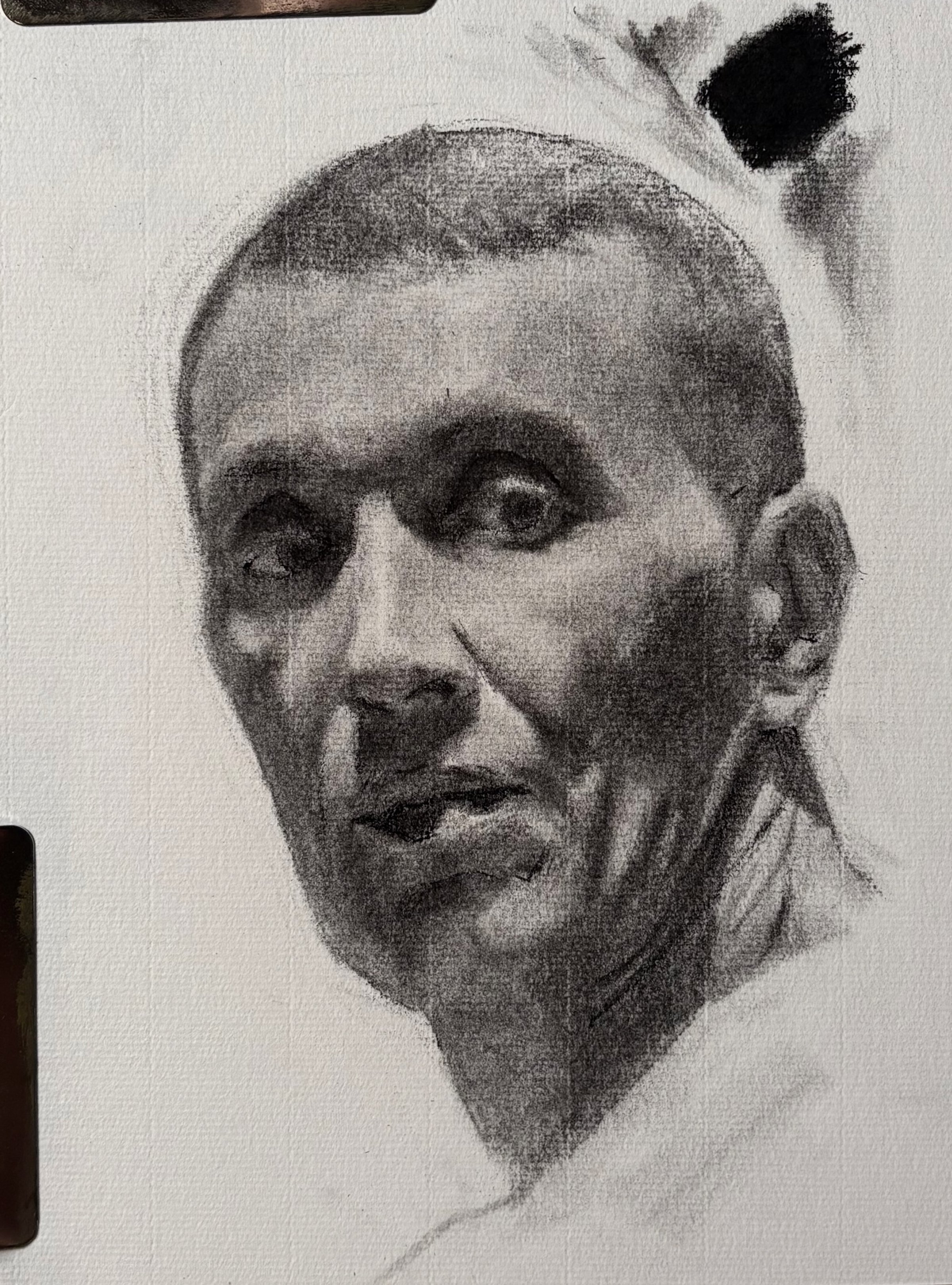
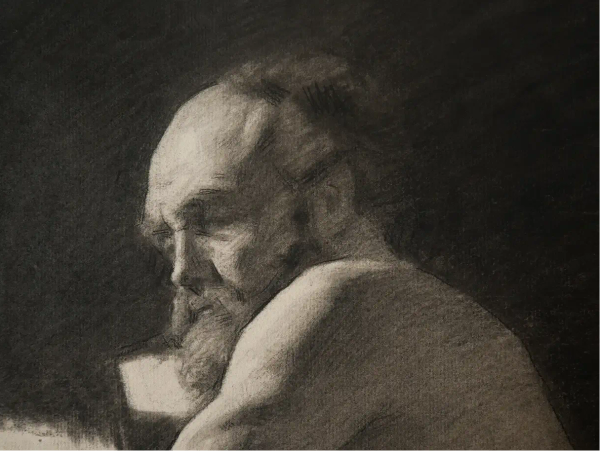
The portrait above benefits from the year of work I’ve described. I’m better at representing planes of light and grouping values, and I have a greater propensity to create striking work. I completed this portrait in around 3 hours, half the time of the first example.
I’ve realized the mode of diagnosing problems from the figure and seeking to resolve them during the next is the true structure of my training. I practically never find myself wondering what I should do next because when the syllabus for improving draftsmanship is the human figure itself, there is never a lack of lessons to learn. Another boon of this study is that it fosters ambition. I often put down the stump and charcoal to explore other mediums and subject matter. My foundation of draftsmanship props up and perpetuates all of my explorations. The 12 hour charcoal figure has been a barometer to measure from, and it is my desire for a greater picture that’s guided me. Most importantly, it is training that has equipped me to do more than study and attempt to create skilled, original work like the masters before me.